



Breast cancer screening programmes read each mammogram twice, even though around 97% of those are normal. Under the weight of the radiologist shortage, screening programmes cannot be sustained this way.
Everyone serious about building AI for breast cancer screening understood where this had to lead already ten years ago: sooner or later, AI would report a share of the normal mammograms on its own. Whether AI could do that job safely was the open question back then.
Today, Vara became the world’s first CE-certified AI product for reporting a screening mammogram as normal, with no radiologist reading it.
It took us ten years to get here. What made it possible can become a template for autonomous AI across healthcare.
What “autonomous” means
AI has been part of radiology for some time, and the word “autonomous” is used loosely across the field. To understand Vara’s new certification, it helps to be precise about the terminology.
Most AI tools in radiology have started as CADe (computer-aided detection), even before deep learning emerged around 10-15 years ago. A CADe tool marks a region for the radiologist to look at, without judging how suspicious it is. Companies like iCAD and Hologic have established CADe since the early 2000s. We owe some of today’s adoption to this early generation of AI systems, but their recurring problem has been that they produce too many false positives – findings flagged that turn out not to be suspicious.
With the rise of deep learning technology around a decade ago, most companies have moved on to what is commonly referred to as CADx (computer-aided diagnosis). This generation of products marks a finding and also assigns a level of suspicion or categorization of the lesion (e.g. mass, calcification). Almost all modern breast AI, Vara included, has worked at this level for the past years. It runs concurrently with the radiologist, as a component of the read rather than a replacement for it. Over the past ten years many such tools have emerged, and few have earned the trust and adoption of the radiology community. Fewer still have been tested in prospective studies, which are considered the only way to demonstrate real clinical benefit. These few benchmark AI systems lead to higher cancer detection rates than human-only screening, while at least keeping false positive rates at the same time.
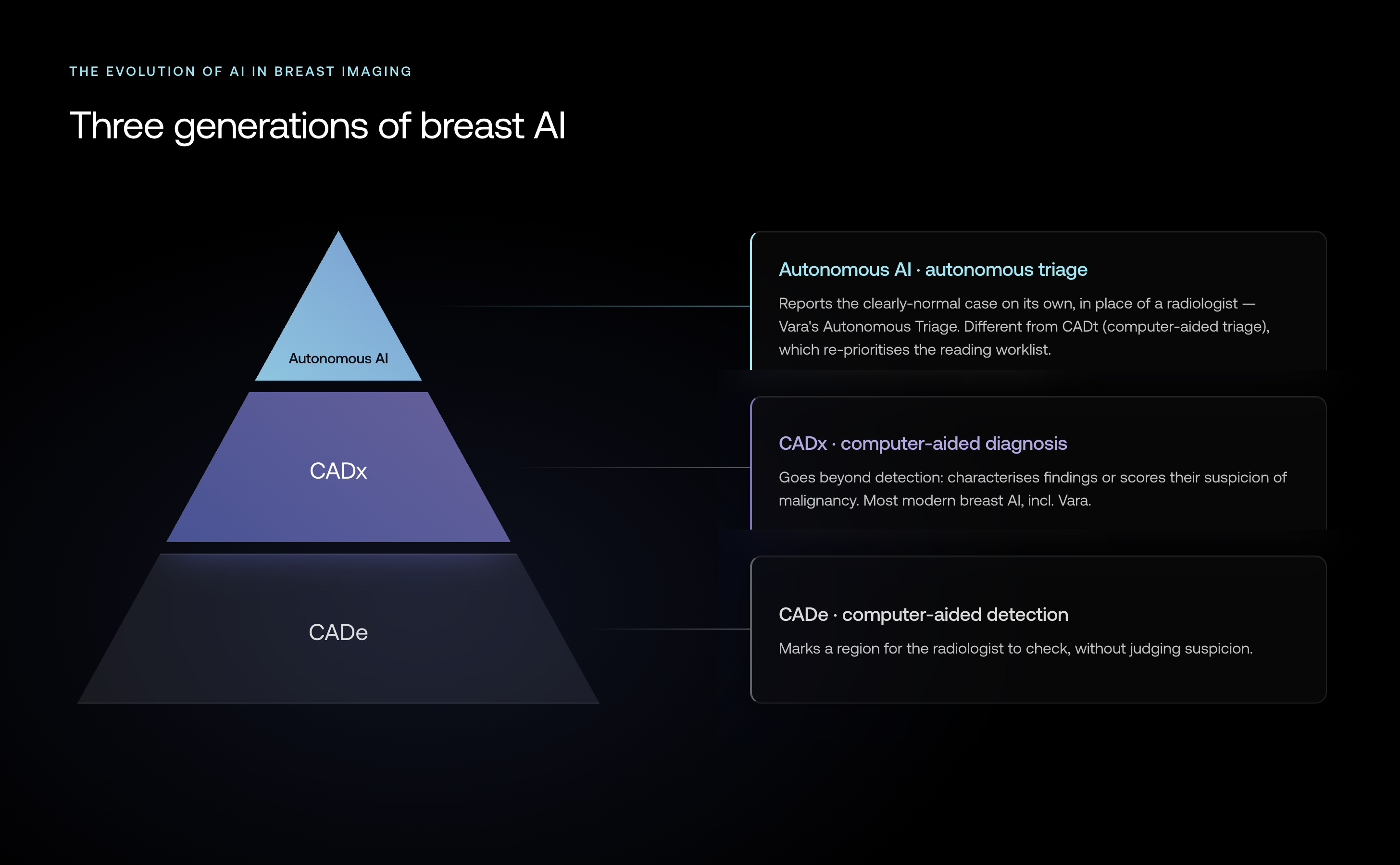
Despite these promising results, none of these AI systems have emerged in the category of Autonomous AI, which is distinctly different from both CADe and CADx. An autonomous AI reports a case on its own, in place of a radiologist rather than alongside one. This promises to take repetitive work from radiologists, so they can focus on what matters. Many years ago, IDx-DR became the first autonomous AI in diagnostic imaging, for diabetic retinopathy in ophthalmology. But breast imaging had never reached it.
Vara’s latest CE certification, Autonomous Triage, falls into this category. For the exams it classifies as clearly normal, no human needs to evaluate the exam. That is the milestone the whole field has been walking towards but stayed uncrossed.
Why it was possible for Vara
The obstacle had little to do with the performance of the algorithms. Besides Vara, a select few AI tools have been evaluated in prospective studies and have the potential to deliver real clinical impact.
There were two challenges the industry had not answered yet:
The first: even the best model’s performance can shift once it operates outside the controlled conditions of a study. Breast cancer screening does not only happen in well-contained settings such as university clinics – it happens nationwide, in rural and urban areas alike. An AI system’s performance can drift when it meets new hardware, new sites with different workflows, or a changing screening population, as is happening now with the age extensions across European programmes. What matters is how the system performs in the real world, rather than how it scored on a fixed dataset, or once, in the past, in a prospective study.
The second is the EU AI Act, which requires a human to stay on the loop for high-risk applications. Continuous oversight has to be built into the system itself, not added afterwards.
Vara’s CE certification – opening the autonomous category in breast imaging – rested on a safety system we built around our AI to guarantee that oversight. We call it ATMON. We have always believed you cannot deploy AI in screening without watching it. This is patient safety, and AI systems are safety-critical. So every case we have ever put into clinical use has been tracked, all the way back to our first cases in Germany in 2019. Certifying Autonomous Triage is a validation of holding that conviction for all these years against the popular opinions in the industry.
ATMON monitors each site’s operating point, tracks changes in mammography hardware, system health and daily performance signals, watches cancer detection and recall rate, and reverts a site to full radiologist reading whenever those signals move outside defined limits. It is built on seven years of continuous monitoring of how our AI performs in the real world, on every single case.
In plain terms, Vara’s Autonomous Triage is similar to an autopilot in aviation. It handles the long, stable stretches of reporting normals in organized screening. But ATMON tells the radiologists when to take back control, just like experienced pilots take over for takeoff, landing and critical situations.
The impact on the industry
Screening programmes will not adopt autonomous triage in clinical practice tomorrow, and they are not meant to. What the certification establishes is a framework for deploying autonomous AI safely.
Until now, no AI system existed in this category, so screening guidelines had nothing to pick up. Now they do. That changes the conversation about what the future of screening programmes should look like, and it enables broader prospective research on autonomous systems deployed in real-world screening.
Beyond breast imaging, we believe the safety technology behind autonomous triage – ATMON – may serve as a blueprint for how autonomous AI can be rolled out safely across healthcare.
And even where existing and new Vara customers do not switch to autonomous triage (or their screening guidelines do not yet permit it), they can be assured that the same safety technology protects the clinical integrity of their AI in every other use case.
Ten years ago, this was a promise. Today it is certified. Vara is committed to the step that must follow over the next ten years: rolling it out responsibly, one programme at a time.
Find the full press release here: LINK
Vara (MX Healthcare GmbH) is the Berlin-based AI company building the leading platform for population-based early cancer detection. More than 60% of Germany’s organised breast screening programme runs on Vara, at 250,000+ screenings per month. PRAIM (Nature Medicine, 2025) is the largest prospective AI study in healthcare to date.